
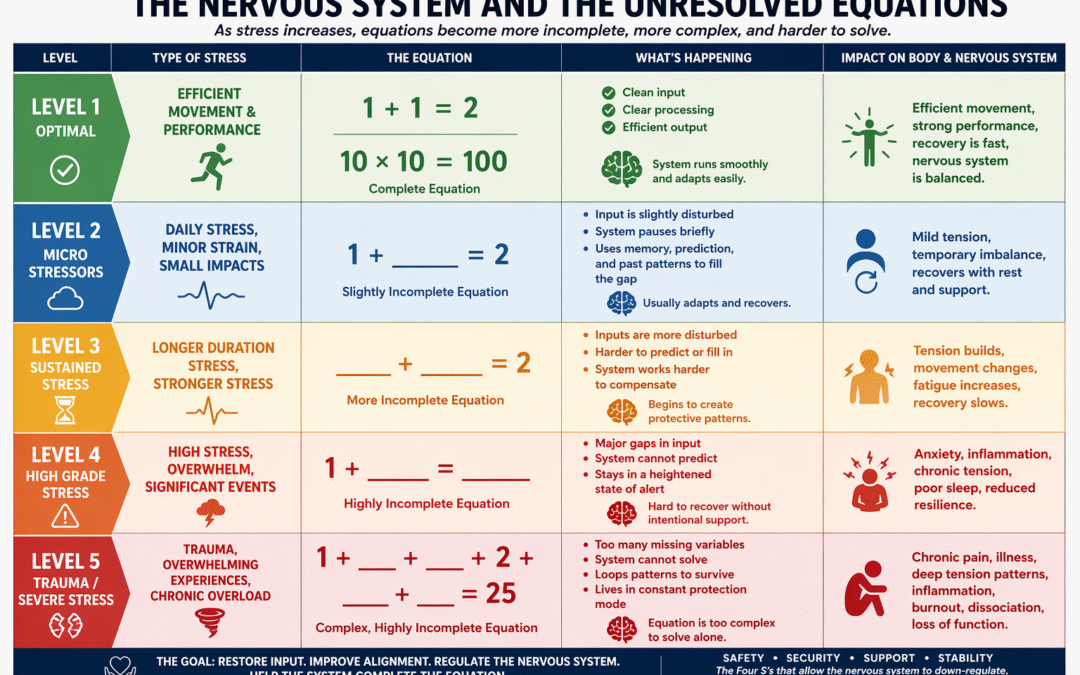
How the Nervous System Processes, Predicts, and Learns to Resolve.
Every second of your life your nervous system is solving equations. Not equations as we learned in school, but biological equations that determine how you move, breathe, feel, and respond to the world around you. The nervous system receives input, the brain interprets it, and an output is produced.
Input → Interpretation → Output
This process is continuous, dynamic, and is happening across billions of neurons firing and communicating per second. The brain is constantly predicting, comparing, and updating itself based on incoming sensory input, a concept described by Karl Friston in predictive processing theory.
When these “equations” are complete it can be processed efficiently. The nervous system operates with minimal friction, maintaining flow, integrity and stability.
The brain is not just reacting to the world, it is predicting it. It builds internal models based on past experiences and uses those models to anticipate incoming sensory input.
“Cool right ! “
When reality matches the prediction, the system runs efficiently and with very little effort. However, when there is a mismatch, called a “prediction error,” the brain will find a way to adapt and update its internal model to reduce that error in the future. This continuous loop of prediction and correction is what keeps movement, behavior, and physiological responses smooth, flexible, and adaptive.
Next, let’s go over the different levels of stress and how it affects the nervous system.
Level 1 stress
Most of the time, these equations are solved instantly and effortlessly. A level 1 stress is considered a low grade stress. The nervous system is figuring out:
- how to move a light weight object
- driving short distances
- school stress
- general movement
- what to eat in the day etc…
The nervous system can problem solve these equations easily. Our nervous system is far more complex, but for educational purposes we are going to simplify this equation example.
- 1 + 1 = 2
- 2 + 5 = 7
- 10 × 10 = 100
Our brain is constantly receiving these types of equations. They are complete and uninterrupted, therefore, easy to process and adapt smoothly.
Level 2 stress
Not every experience is perfect. There are moments of more than normal type of stress. When this happens, the equations are interrupted and incomplete. They may present themselves now as:
- 10 × ___ = 100
- 1 + ___ = 2.
There are now some missing pieces, and instead of staying in flow, the nervous system pauses for a moment and reallocates resources to solve the equation. It uses memory and pattern recognition to fill in the missing variable until it can complete the pattern and resolve the problem. Eventually, the system recognizes the correct inputs.
- The blank becomes a “10,” the other blank becomes a “1,” and the equation is now completed and able to be processed and allocated accordingly.
In real life, this shows up as moments of running late and figuring out how to get somewhere on time, or someone cutting you off in traffic. These are temporary stressors that disrupt the system briefly, but are ultimately resolved as the nervous system adapts.
Level 3 stress
“Stress is relative, and what is manageable for one person may be overwhelming for another.”
– Joseph Gonzalez
Under higher levels of stress the equation becomes less clear. There are more blanks to the equation, making it more complicated for the nervous system to process. Now, the equation may look more like this:
- ___ × ___ = 100
- __+ __ = 2
Higher stress creates too many unknowns (blanks) and not enough reliable information. Predictions become less accurate, errors increase, and the system begins to loop. You must have heard of a stress loop, well, this is an “equation loop.”
Instead of resolving efficiently, the nervous system loops the equation, starts guessing, compensating, overcorrecting, and anticipating mistakes. This creates inefficiency throughout the whole body increasing risk of injury, irregular breathing, elevating heart rate, and activating a full stress response state.
- Muscular patterns begin to shift, with over-recruitment of secondary muscles, under-recruitment of primary muscles, and excessive load on stabilizing structures, all of which slow recovery and prolong tension.
Level 4 & 5 stress
As the unresolved equations accumulate, the nervous system becomes overloaded. This reflects the work of Bruce McEwen. He introduces the idea of one incomplete equation becomes many. One stress pattern reinforces another and one compensation leads to additional imbalance.
Over time, the system becomes overloaded, and according to Bessel van der Kolk in The Body Keeps the Score, the brain’s alarm system becomes heightened. Interpretation of input becomes less accurate and the connection between brain/ body becomes disrupted. The system remains in a defensive state, because it does not have enough accurate information to resolve the equation. This now becomes a compounded experience, such as:
- loss
- conflict
- betrayal
- Car accidents
- physical trauma
- Emotional trauma
- Etc…
The equations become even more complex. The nervous system is now dealing with multiple complex equations.
- 1 + 2 + 8 + 7 + ___ + ___ + ___ + ___ = 85.
There are too many gaps and total uncertainty that the nervous system becomes overwhelmed all the time. At this stage, dysregulation emerges and the nervous system begins to form patterns based on incomplete data. This leads to altered movement patterns, emotional instability, chronic tension, chronic inflammation, sleep disturbances, chronic digestive stress, chronic anxiety, hypervigilance, irritability, poor recovery, weight gain and food sensitivities.
The holistic system is now failing and falling behind as it attempts to solve too many unresolved equations.
More Insight
- For many individuals, these equations do not begin later in life, they can start as early as birth and shape development from the very beginning.
Research by Nadine Burke Harris on Adverse Childhood Experiences (ACEs) shows that early life stress, including abuse, neglect, and household dysfunction, can create toxic stress when experienced repeatedly without support. This disrupts brain development, hormonal balance, immune function, and a stable nervous system.
Instead of experiencing complete equations at a young age the nervous system may skip to more complex equations.
Such as: 1 + ___ = __?
Over time one can develop multiple missing variables, increasing the likelihood of chronic stress, emotional instability, chronic inflammation, and disease at an early age.
But there’s hope. ❤️
The nervous system already knows what to do and how to heal. It simply needs the right input.
This is where the work of Joseph Gonzalez is integrated.
Joe, believes the nervous system is constantly seeking conditions of safety, security, support, and stability. His Four S’s create the environment in which the system can reconnect, reorganize, and resolve. This is achieved by his therapeutic programs such as: Posture Reset, Structural Exercise Therapy, Diaphragm Activation, and Neuro-Jaw Reset.
“I believe that unresolved equations manifest as tension in our bodies.” — Joseph Gonzalez
When we relieve tension from the body it releases the missing parts to the equations. As tension is released, the missing variables begin to reveal themselves, fills in the blanks and input is improved. With improved input, processing becomes available again and the nervous system can now resolve.
Final Thought
“Upright posture is a part of our evolution, therefore, posture alignment is something to aim for.” — Joseph Gonzalez
“In order to be effective, we must treat the source, not the symptoms. Where you feel it is not where it starts.” – Joseph Gonzalez
We are not broken, our nervous system just needs help solving equations.
Posture Lab LA
Live Long. Live Well.