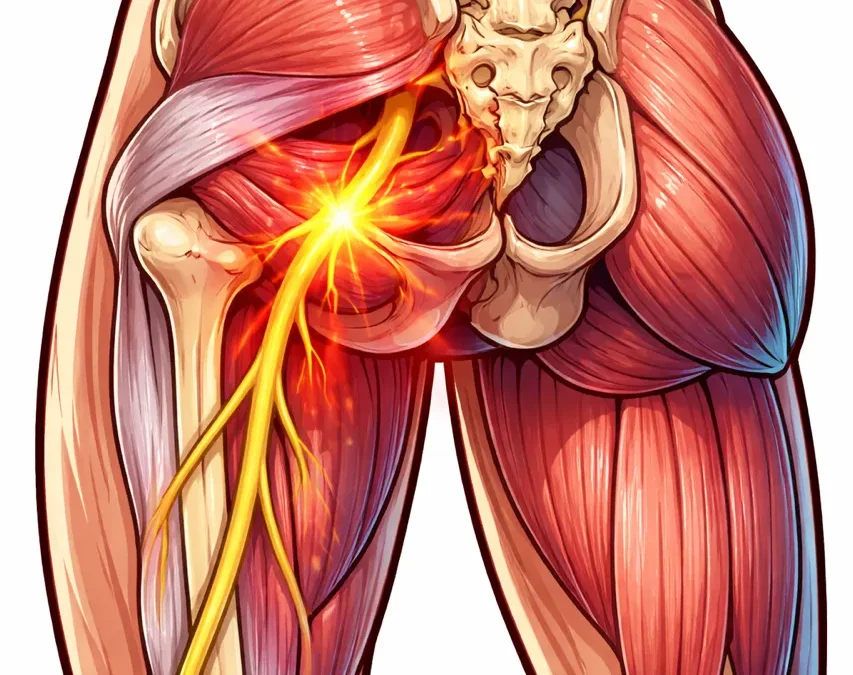
Sciatica is one of the most common complaints in musculoskeletal health. It often presents as pain, tingling, or numbness radiating from the lower back into the glute and down the leg. While many people believe sciatica originates only from the spine, the reality is that hip muscle imbalance is frequently a major contributor.
At Posture Lab LA, we often observe a pattern where overactive hip flexors and stabilizers inhibit the glute muscles, altering pelvic mechanics and placing stress on the sciatic nerve.
Understanding this imbalance is key to resolving the problem.
⸻
The Role of the Sciatic Nerve
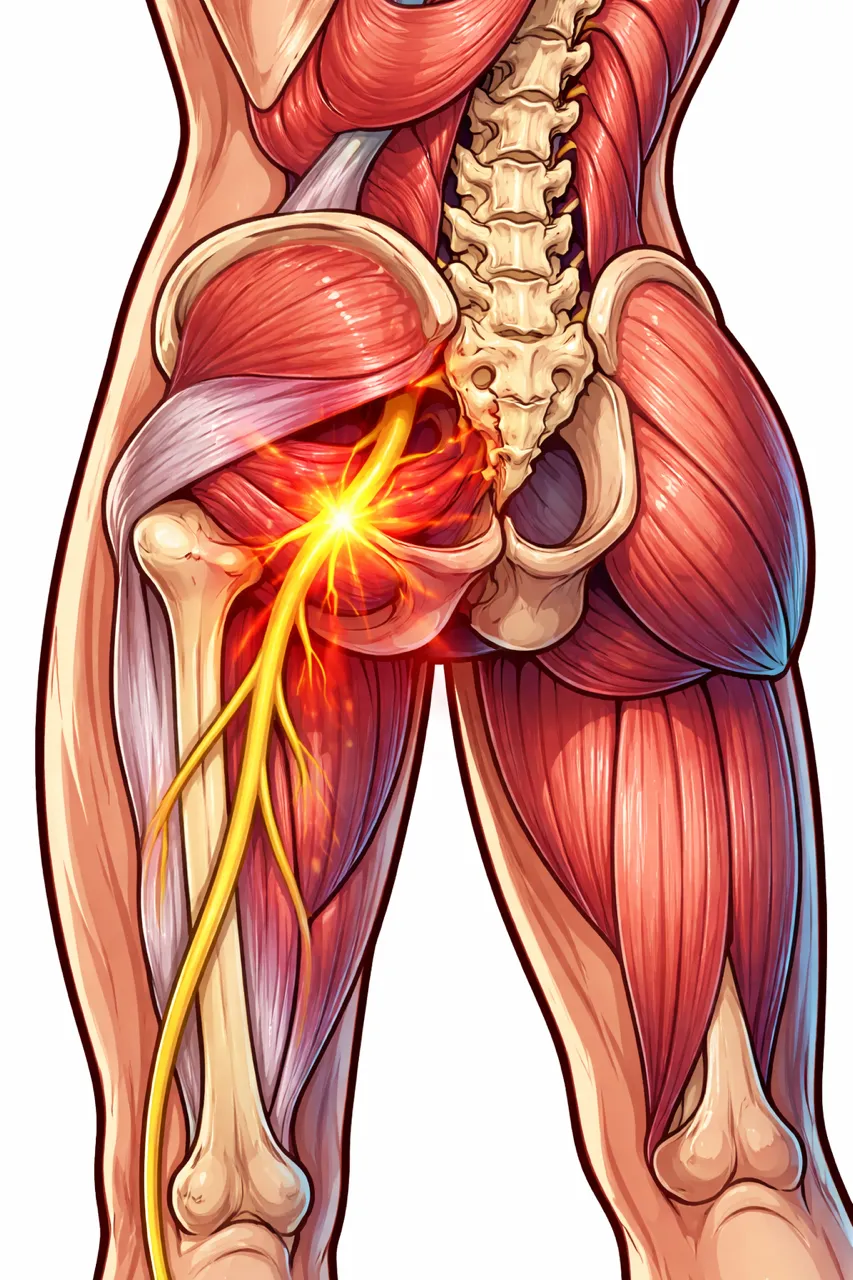
The sciatic nerve is the largest nerve in the human body. It originates from the lower lumbar and sacral spine (L4–S3) and travels:
- through the pelvis
- beneath the glute muscles
- down the back of the leg
Because of this pathway, any dysfunction in the hip or pelvis can affect the nerve.
Tension, compression, or altered mechanics in the surrounding muscles can irritate the nerve and produce sciatica-like symptoms.
⸻
The Hip Flexor Dominance Pattern
Modern lifestyles often place the body in prolonged sitting positions, which can cause certain muscles to become chronically shortened and dominant.
The most common overactive muscles include:
Psoas
The psoas connects the lumbar spine to the femur and is one of the strongest hip flexors. When tight, it can pull the pelvis forward and increase lumbar compression.
Rectus Femoris
Part of the quadriceps group, this muscle crosses both the hip and knee. When shortened, it reinforces hip flexion dominance and limits proper glute activation.
Glute Minimus
Although technically a glute muscle, the glute minimus functions more as a hip stabilizer and internal rotator. When overactive, it can contribute to tension around the lateral hip and irritate structures near the sciatic nerve.
These muscles can create a pattern where the front and side of the hip dominate movement, preventing the glutes from doing their primary job.
⸻
How This Contributes to Sciatica
When the glutes fail to activate properly:
- Hip extension becomes limited
- The pelvis becomes unstable
- Smaller muscles around the sciatic nerve become overloaded
- Compression or irritation of the nerve can occur
In many cases, symptoms attributed to spinal disc problems may actually be driven by muscular imbalance and altered movement patterns in the hip.
⸻
The Bigger Picture
Sciatica is rarely just a nerve problem. It is usually a mechanical and neurological coordination issue within the hip and pelvis.
When the body’s movement patterns are balanced:
- the glutes activate properly
- the pelvis stabilizes
- the spine experiences less stress
- nerve irritation decreases
The solution lies not only in treating pain, but in restoring the body’s natural movement system.
⸻
At Posture Lab LA, we focus on identifying these patterns and helping the body return to its natural balance — because when structure and movement align, healing becomes possible.
Live long. Live well.